Data centers rely on servers, networking equipment, and storage systems to process and transmit information around the clock. These devices generate substantial heat during operation, making effective thermal management essential for reliable performance. Unlike ordinary office spaces, data centers require cooling systems designed to handle continuous heat loads and maintain stable operating conditions. This is where precision air conditioners play an important role.
What Is a Precision Air Conditioner?
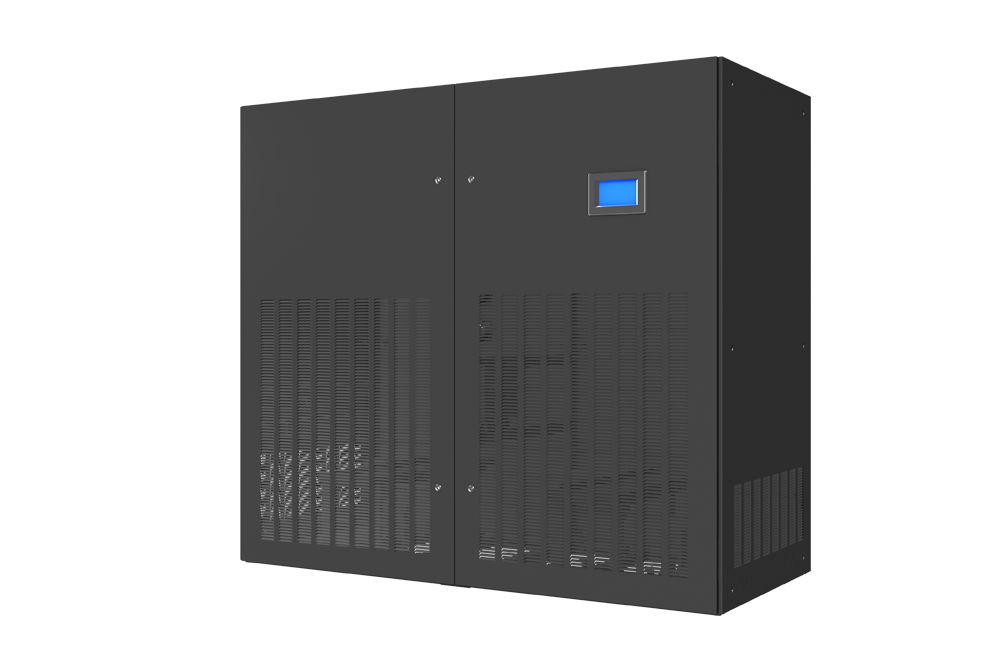
A precision air conditioner is a cooling system designed specifically for environments that require accurate temperature control and reliable operation, such as data centers, server rooms, and telecommunications facilities.
Unlike conventional comfort air conditioners, which primarily focus on human comfort, precision air conditioners are engineered to manage the heat generated by electronic equipment. Depending on the system design, they can provide continuous cooling, controlled airflow, and humidity management to help maintain suitable environmental conditions for IT equipment.
How Does a Precision Air Conditioner Work?
The primary function of a precision air conditioner is to remove heat generated by IT equipment and maintain stable indoor conditions. Its operation involves several key processes:
· Heat removal: The cooling system absorbs heat from the indoor air and transfers it through the refrigeration cycle to the heat rejection side.
· Air circulation: Fans distribute conditioned air toward the equipment and help maintain the airflow required by the room layout.
· Temperature control: Sensors monitor operating conditions, allowing the control system to adjust cooling operation according to actual cooling demand.
· Humidity management: Where configured, humidity control helps maintain appropriate moisture levels and reduces the risk of problems associated with excessively dry or humid air.
Effective cooling also depends on proper airflow organization. Separating hot and cold air streams, avoiding airflow obstruction, and matching cooling capacity to the actual IT load can help reduce cooling inefficiencies.
Key Benefits of Precision Air Conditioning for Data Centers
1. Stable Operating Conditions
Precision air conditioners help maintain suitable temperatures for servers and other electronic equipment, supporting reliable data center operation.
2. Continuous Cooling Capability
Data centers operate day and night, so their cooling systems must be designed for continuous service and dependable performance under changing heat loads.
3. Targeted Airflow Management
Proper airflow distribution helps deliver cooling where it is needed and reduces the risk of localized overheating, particularly in high-density server environments.
4. Flexible System Configuration
Cooling capacity, airflow, control functions, and equipment arrangement can be selected according to the facility's size, rack density, and operating requirements.
A Precision Cooling Application in Indonesia
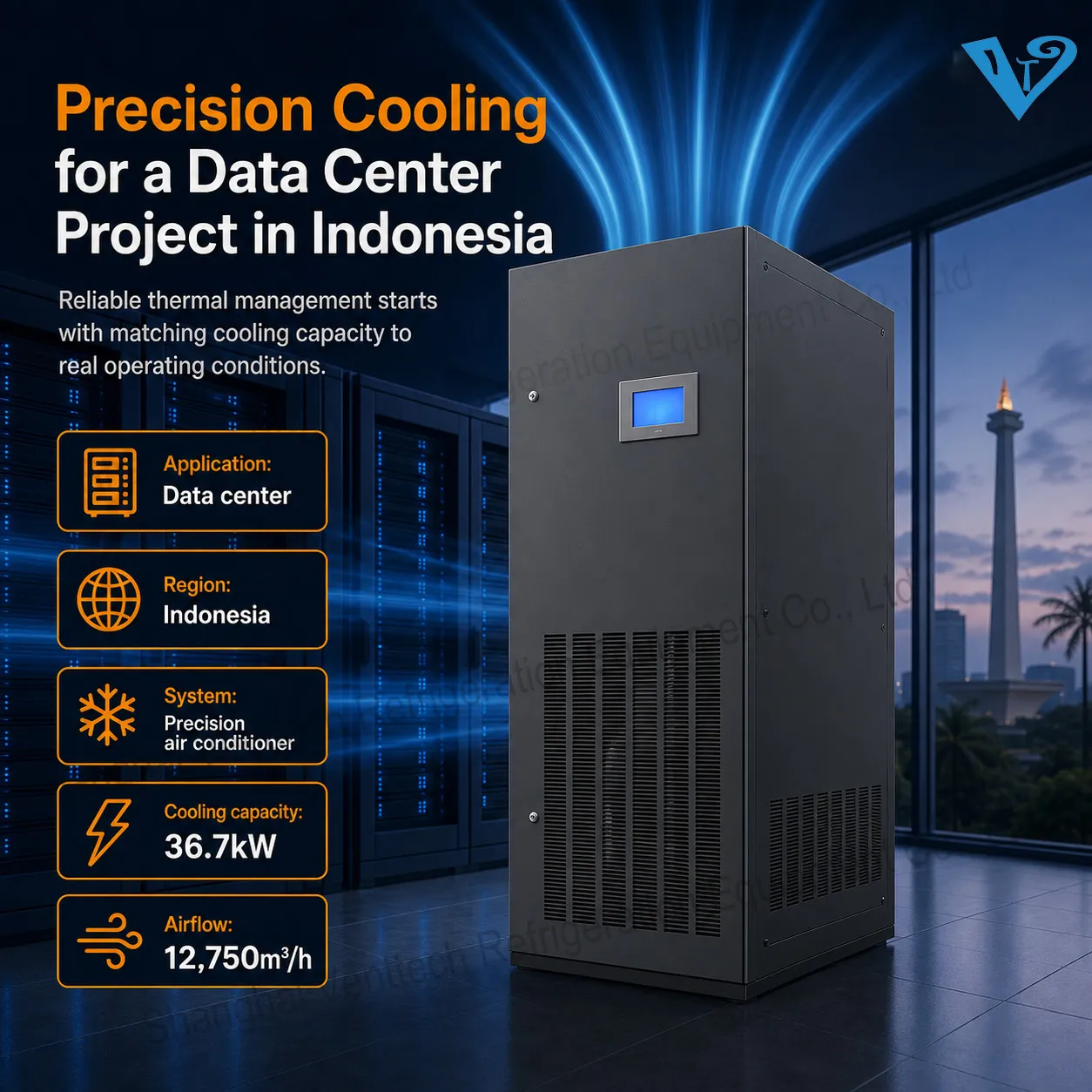
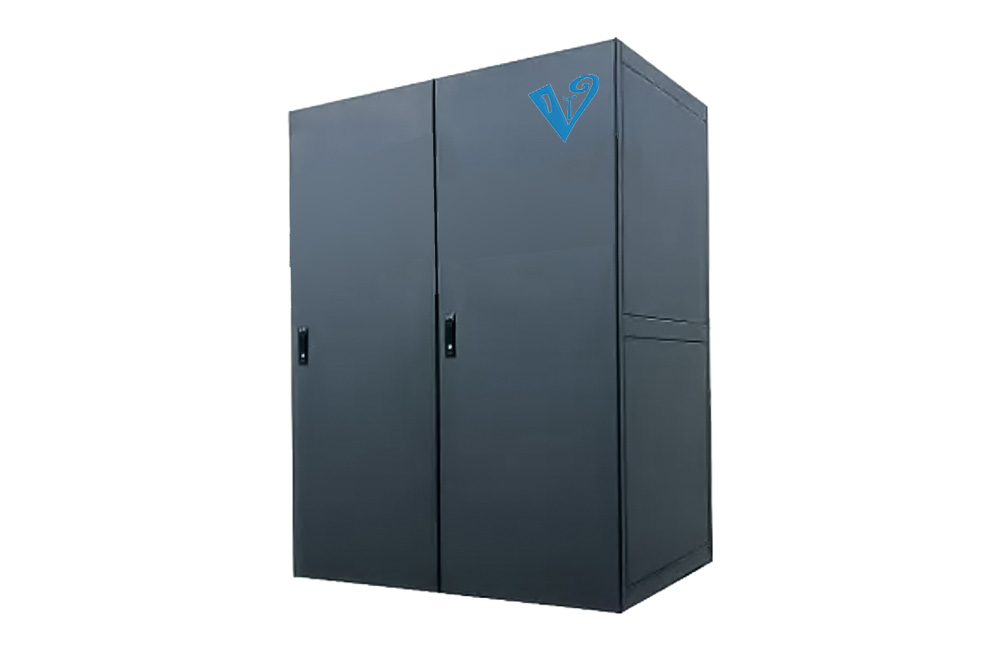
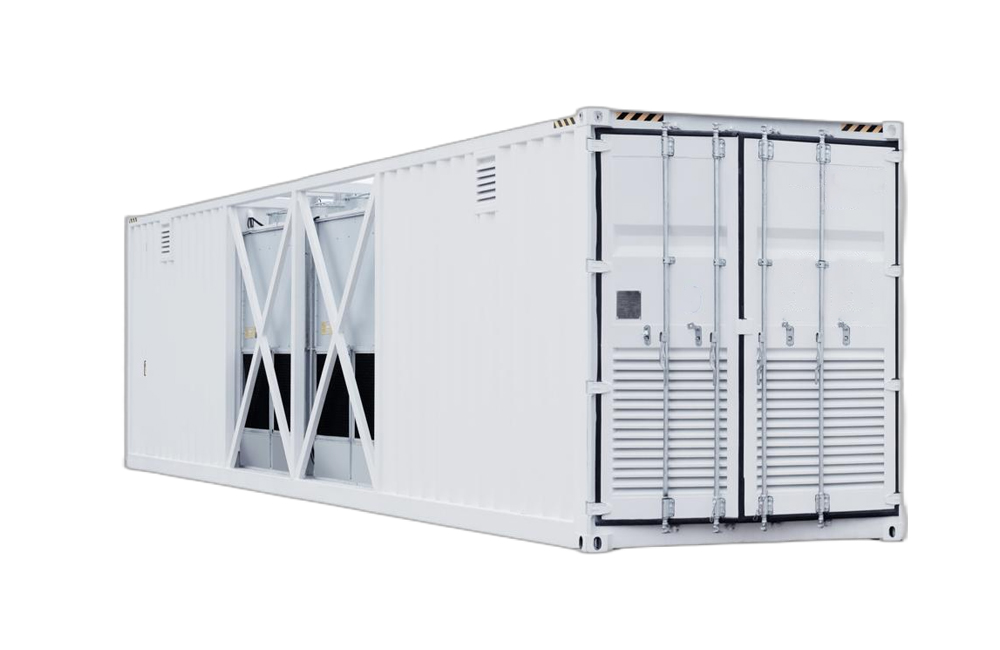
For a data center project in Indonesia, VENTTK precision air conditioning equipment is configured with a cooling capacity of 36.7 kW and an airflow rate of 12,750 m³/h. These specifications illustrate two important factors in precision cooling selection: the amount of heat that must be removed and the airflow required to distribute cooling effectively.
Actual performance depends on the IT heat load, inlet air temperature requirements, room layout, and other operating conditions. Therefore, selecting a suitable unit requires evaluating both cooling capacity and airflow rather than relying on either parameter alone.
How to Select the Right Precision Air Conditioner
When choosing a precision air conditioner for a data center, consider the following factors:
· IT heat load: Calculate the total heat generated by servers, storage systems, and networking equipment.
· Required airflow: Ensure that the airflow matches the equipment layout and cooling distribution strategy.
· Operating conditions: Consider ambient temperature, humidity, and the installation environment.
· Control and monitoring: Evaluate temperature monitoring, alarm functions, and compatibility with the facility's management system.
· Reliability and redundancy: Determine whether backup cooling capacity or an N+1 configuration is required.
Conclusion
Precision air conditioning is an important part of data center thermal management. By combining appropriate cooling capacity, effective airflow distribution, and responsive controls, a well-designed system helps maintain stable conditions for critical IT equipment. VENTTK provides precision cooling solutions that can be configured to meet the requirements of data centers and other technology-intensive facilities.



.jpg)
.jpg)
65.webp)
265.webp)





ft.webp?x-oss-process=image/resize,w_100/quality,q_100)
.webp?x-oss-process=image/resize,w_100/quality,q_100)